


There is a particular kind of obedience drilled into us so early it feels like good manners.
It’s the obedience that demands we conform to the socially acceptable rules of smiling and hiding our deepest wishes, our fears, our truths, our selves.
It’s exposed in moments that seem too small to matter.
Someone says something.
A joke lands where it shouldn't.
An interruption redirects a conversation.
A boundary is crossed so casually it almost feels impolite to notice.
Nothing dramatic happens. No voices are raised. No one storms out.
And yet, you know. You’ve stepped outside the invisible boundaries of belonging.
In that exact fraction of a second, before logic or language can catch up, the body knows. Something tightens behind the ribs. A quiet alarm goes off in the nervous system.
And right beside it, the old, well-oiled machinery kicks in.
Don’t make it awkward. Keep the peace. Just swallow it and smile.
Outwardly, the face relaxes. The shoulders drop. A compliant nod is offered to keep the social machinery greased and running smoothly.
An apology you don’t owe to cover the sudden, hot flush of feeling like a “bad girl” caught out of bounds. A pre-emptive sorry handed over on a silver platter, acknowledging a crime that was never committed, just to soothe the unease of others and hide the flush of your embarrassment.
Inwardly, the betrayal is complete. Outwardly, it never happened.
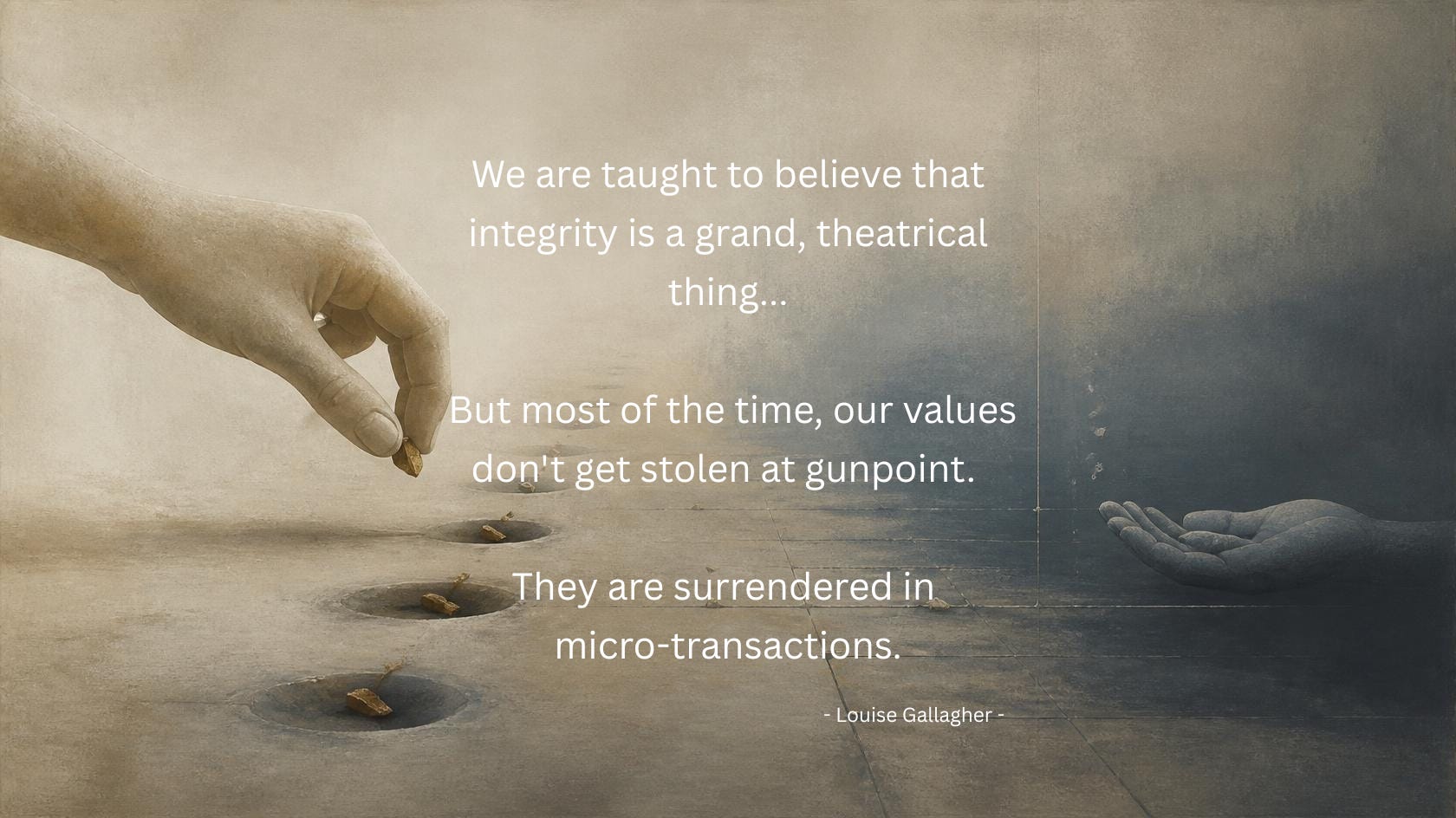
We are taught to believe that integrity is a grand, theatrical thing — a sword we draw in public squares to defend high principles. But most of the time, our values don’t get stolen at gunpoint. They are surrendered in micro-transactions.
We trade them away for a smooth transition. We barter them for the cheap comfort of not causing a ripple. Every time we offer an apology we don’t owe, and nod along to an unspoken demand that we shrink, conform, or perform the role we didn’t sign up for, we leave a small piece of ourselves behind.
The loss is quiet. Cumulative. Until one day you look up and realize you are a stranger in your own skin, wondering why your own voice feels thin and brittle.
Maybe personal ethics aren’t about being bulletproof. Maybe they start the moment you decide to stop acting as an accomplice to your own erasure.
The awareness doesn’t always happen right then and there. Most often, it doesn’t. The architecture of conformity is ancient. It was laid down in our bones long before we knew we had a choice.
But the way out isn’t about finding a grand escape route.
Sometimes wisdom just takes its time walking home. Sometimes courage is simply the quiet realization that you are done apologizing for existing outside the lines.
There is no expiry date on coming back to yourself.
Perhaps that is what personal ethics really are.
Not perfection.
Simply the willingness to stop giving away the keys to your integrity and instead, stay with the question:
Will I stay with myself here?
An excellent, non-offensive yet integrity-affirming comeback is always: “I understand what you’re saying, but I don’t see it that way.”
me: (either) Can we agree to disagree on this? or: I'm sorry I can't discuss this 'subject' with you. I'd get either angry or frustrated and I can't handle these emotions right now.
me also: I do hear you, but I have a different viewpoint. mostly, it's not worth a further discussion (for me), because the same subject, the same theme has already been discussed to death before. And I don't mind truly dumb ppl too much, what I can't stand any longer, are ppl who are too sure of themselves, not able or willing to even try seeing something from another angle, too stubborn to look at themselves and pondering their words. I then think to myself: I don0t need this any longer - I'm too old to get hecked up about this. When it gets really tough and I think to myself that the 'other person' is an idiot, I usually say: 'I'm sure you're right' and just leave it like that. It's astonishing how these few words shut ppl up!